
There has been a huge growth in non-surgical treatments and hair restoration surgery in recent years. For many members of the public this leads to great confusion. The JCCP has published a series of information sheets to give a brief explanation of each procedure and the risks involved.
The JCCP currently recognises the following five procedural modalities that are performed by our Registrant Practitioners:
These procedural modalities are simply the treatments that we regulate currently according to a set of prescribed practice standards (as determined by the Cosmetic Practice Standards Authority) and formal educational qualifications that are set down by the JCCP.
In 2013 Sir Bruce Keogh presented his Government commissioned report into the cosmetic/aesthetic industry, which outlined a range of failings that present a risk to patients and service users. In response, the Government commissioned Health Education England (HEE) in 2013 to work with industry stakeholders and professional regulators to develop a framework of agreed qualifications and standards, to address practitioner failings, to improve public protection and to mitigate risks that might occur as the result of harmful practice.
Under the umbrella of HEE, multiple industry stakeholders and experts:
Whilst 5 modalities are currently recognised by both the JCCP and by the CPSA, these are likely to increase in number in the future as new risks to person/patients are identified. It is the specific role of the CPSA to review new treatments as they emerge, to assess risk and where necessary to develop new standards.
For each of the modalities your JCCP practitioner is registered to provide, you can be sure that they:
Competence is the combination of training, skills, experience and knowledge required to perform a task safely. Qualifications are a key part of competence and, for your safety, the JCCP recognise qualifications within this wider definition of competence.
The qualification and level we record may not be the same as the modality a practitioner is registered for, but it is important we record it because it forms a substantial part of their competence. For example, nurses and doctors with a degree (level 6) in nursing or medicine have met many of the competencies required for level 7 cosmetic procedures. These individuals close the gap by virtue of the skills and experience they have gained over time, and we record them on Category 2 of the register for the level 7 procedures they perform.
It is helpful to know that, alongside qualifications, the application of professional standards of practice provides another pillar of assurance for your safety. Category 2 is only available to specified healthcare professionals who are also regulated through a statutory body that commits them to work within the limits of their competence.
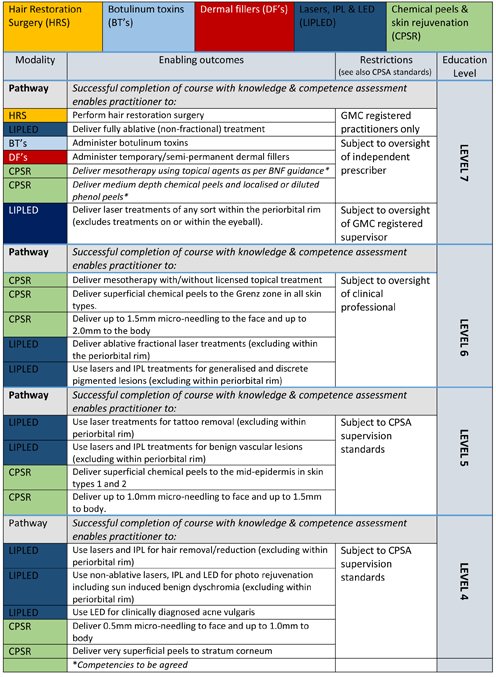
Further information can be found above, including by following the links to other resources. The Treatment Modality Table below sets out the levels of education, gained either through regulated qualifications (Category 1) or demonstrated by other means (Category 2), expected for each procedure. Further information about the different parts and categories of the register can be found here.
Treatment Modality Table
Your session timed-out.
Please Re-Login to Continue.
You have chosen invalid value.
We cannot continue with your application at this time.
Currently you do not meet the criteria to join the JCCP register and we cannot continue with your application at this time.